Posts

Showing posts from May, 2008

Where in the world?

Image
When you work in the Tourism sector it is important to have a good knowledge of where places are: imagine you have to book a holidays for some clients, or you just have to recommend some vacation to a client or simply you are just curious about exactly where a tourist comes from. Check your world geography playing this game. I bet you don´t find it that easy. Good luck! PLAY! If you want to concentrate on your European geography knowledge, you can do this QUIZ . Thanks to Ana Concejero for letting me know about the World Traveller IQ game.

Travelling in Europe

Image
There is an interesting website that gathers all the information you need to travel within Europe. Have a look! Remember Europe is a continent with thousands of years of history and a rich cultural heritage! So there is much for the traveller to discover and explore and all made much easier thanks to the European Union (EU). You can cross many borders within the EU without being checked and the euro makes it easier to move from country to country. If you drive, your driving licence and motor insurance policy issued in one EU country are valid in all the others. And you can use your mobile phone everywhere.

Working in Europe

Image
When you apply for a job, it is usual to include a curriculum vitae , or CV (called résumé in the US ). This is a list of your personal details, educational history, qualifications, experience, and interests—that is to say, the story of your life from a professional point of view. Europass is a new way of helping people to make their skills and qualifications clearly and easily understood in Europe (European Union, EFTA/EEA and candidate countries) and move anywhere in Europe . There are many different models of CVs but you should definitely start using the Europass Curriculum Vitae . Have a look at different models of Europass CVs and then write your own Europass CV online .

Celebrating Europe Day (9 May)

You may have come across a reference in a diary or elsewhere to the fact that 9 May is "Europe Day" and perhaps asked about its significance. Probably very few people in Europe know that on 9 May 1950 the first move was made towards the creation of what is now known as the European Union thanks to The Schuman Declaration of 9 May 1950. I have a question for you all as a way to celebrate "Europe Day." WHAT DOES IT MEAN TO YOU TO BE EUROPEAN? Please, feel free to participate leaving your messages! Have a look at this video for inspiration!

Is Europe a country?

Image
When working in the Tourism Industry, it is important to have a good knowledge of geography and know where countries are. Imagine that you have to give someone advice on going to some country and you don´t even know where it is on the map. It would be very embarassing! Have a look at this video and see how someone struggles with locating Budapest and states Europe is a country: *Please ignore the comment on women.

How many languages do you speak?

Image
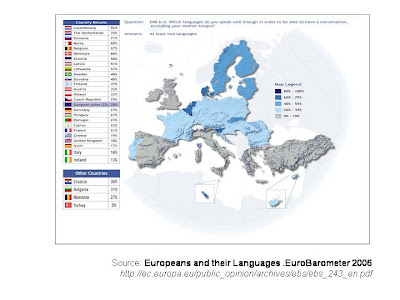
Language learning is something that everyone can do. You're never too old or too young to learn a language! In many countries it is quite normal for most people to be able to use several languages. These people are better able to move between countries for educational, professional or other reasons. Their linguistic skills are attractive to employers. The European Commission wants everybody in the Union to share these benefits. In its 1995 White Paper “ Teaching and Learning: towards the learning society ”, it set the objective of all EU citizens being proficient in three European languages: their mother tongue plus two more. Have a look a t this map from a report of the Eurobarometer of Europeans and their Languages from 2006. Do the countries from Southern Europe have anything in common? If you cannot see the map, click on it.

Describing a festivity

As this weekend the El Rocío festivity is taking place, I found this video about El Rocío in English that can help students to learn how to describe festivities and present them to people who know nothing about it. Enjoy! Spanish Festival - El Rocio

Can you say.....?

One of the most common problems students have is pronouncing English words. Speaking and pronouncing words in a way listeners can understand is a very important skill in the tourism industry. So as not to make a big deal of pronunciation let´s have a look at this video and have a good laugh before starting to work hard again!

The beginning

Image
I have been working with ICT and the teaching of English for several years now. Although the idea of creating a blog crossed my mind many times, I never found the time to sit down and do it. However, today was the day and I finally decided to give shape to that blog that was always lingering next to me. I have been teaching English for Tourism (level B1) at the University of Huelva since 2004. In the last 4 years I have managed to gather plenty of online resources to help my students so I thought why not to share my findings with everybody else? and of course, why not get some feedback from people? As you can read in the heading of this blog, this blog is meant for those people interested in English in relation to tourism, although any other student of English will also find it useful and perhaps some teachers could find useful some links, videos, etc posted here. So I hope this is the beginning of a fruitful blog . . .